Lustrahaus
17th Century Italian Silver Reliquary Crucifix
17th Century Italian Silver Reliquary Crucifix
Couldn't load pickup availability
17th-Century Italian Silver Reliquary Crucifix
Overview
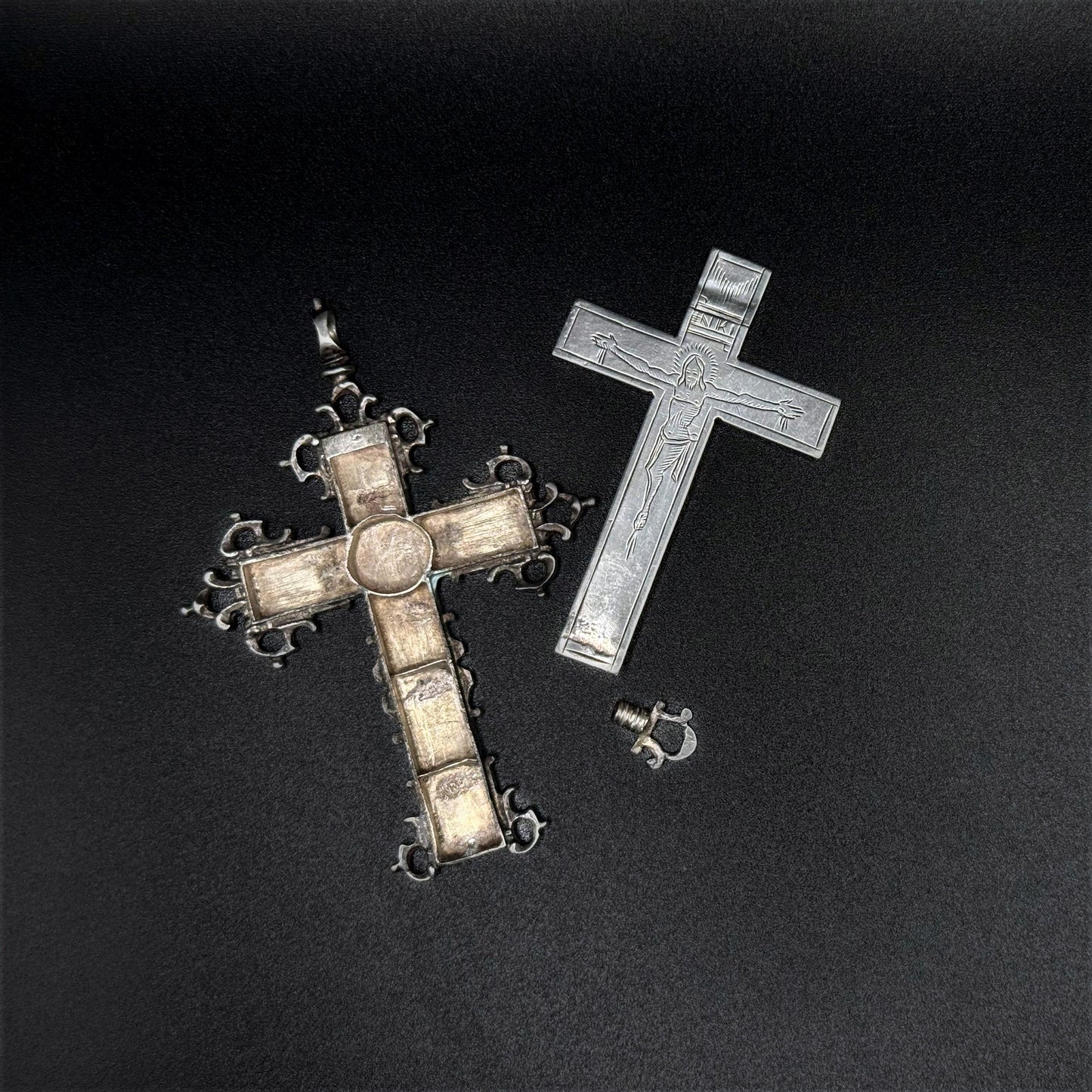
This object is an Italian silver reliquary crucifix, dating to the 17th century. It is a devotional artefact made for personal use during a period of intense religious life in Italy marked by plague, war, and the Counter-Reformation. The crucifix is constructed with a screw-off base that allows the front panel to be removed, revealing internal compartments. These compartments were originally intended to house relics, such as tiny fragments of bone, cloth, or blessed papers.
Unlike ornamental jewellery, this crucifix was created as a portable shrine and a focus of personal prayer, meditation, and protection.
It comes from the personal collection of Anthony Phillips, former International Head of Silver at Christie’s, widely regarded as one of the most authoritative figures in European silver and objects of vertu. This provenance significantly enhances its cultural and historical significance.
Physical Description and Construction
- Height: 75 mm
- Weight: approximately 14 g (9 dwt)
- Material: Solid silver
- Structure: Hollow body enclosing reliquary compartments, accessed via a screw mechanism at the base
- Suspension: Integral ring/bail at the top for wearing on a chain
- Decoration: Openwork trefoil terminals surrounding all four arms of the cross, typical of Italian Baroque ornament
The craftsmanship points to Northern Italy, where small personal reliquaries of this type were widely produced for travellers, clergy, pilgrims, and laypeople seeking protection and devotional focus.
Front of the Crucifix: The Corpus of Christ
1. Christ Crucified
The front depicts the Crucifixion in engraved form. The body of Christ is rendered in a manner typical of the early Baroque period:
- elongated proportions
- simplified anatomy
- expressive but restrained carving
- clear delineation of ribs and limbs
- a mild forward curve to the torso, typical of Italian engraving of the 1600s
This style is consistent with Northern Italian devotional imagery of the period, particularly Lombardy and Veneto.
2. The INRI Inscription
Above Christ’s head is the engraved plaque reading INRI, an abbreviation of Iesus Nazarenus Rex Iudaeorum — “Jesus of Nazareth, King of the Jews”. This recalls the inscription placed on the Cross at the order of Pontius Pilate.
3. Radiant Halo
A stylised halo surrounds Christ’s head, symbolising His divinity even in the moment of death.
This is not decorative; it expresses the theology of Christ’s dual nature: fully human, fully divine.
4. Openwork Trefoil Terminals
Around the outer cross are ornate, three-lobed trefoil motifs in openwork silver.
The trefoil represents the Holy Trinity — Father, Son, and Holy Spirit — enclosing the Crucifixion on all sides.
This is classic late-Renaissance/early-Baroque Italian religious metalwork.
Back of the Crucifix: The Arma Christi (Instruments of the Passion)
The reverse of the crucifix bears a complete engraved set of the Arma Christi — the instruments associated with the Passion of Christ. Each symbol invites meditation on a particular moment of Christ’s suffering.
1. The Reed Staff
At the top is a bundle of reeds, recalling the moment Christ was mocked with a reed in His hand as a parody of a royal sceptre. It symbolises humiliation endured willingly.
2. The Scourges / Whips
On one side are the scourges used in the Flagellation. These remind the owner of Christ’s physical suffering prior to the Crucifixion.
3. The Crown of Thorns
Opposite the scourges is the engraved crown of thorns, representing humiliation and spiritual victory through suffering.
4. The Volto Santo (Holy Face / Veil of Veronica)
At the centre is a stylised Holy Face of Christ, representing the legendary veil of St Veronica, believed to carry an imprint of Christ’s face.
This symbol is strongly associated with Italian devotional art of the 16th and 17th centuries.
5. The Rooster (Cock of Peter’s Denial)
Below the face is the rooster, recalling Peter’s denial of Christ. Its presence teaches repentance, human frailty, and forgiveness.
6. The Column (Pillar of the Flagellation)
Below the rooster is the column to which Christ was bound for scourging. This is a common feature of Italian and Spanish Passion imagery.
7. The Lance and Sponge
Crossed behind or beside the pillar are:
- the Spear of Longinus, which pierced Christ’s side
- the Sponge on a Reed, soaked in vinegar and offered to Christ
These symbols represent the final moments of the Passion and Christ’s death on the Cross.
Meaning and Function
A Portable Devotional Tool. In the 1600s, objects like this were used daily for:
- prayer
- meditation
- protection
- remembrance of Christ’s suffering
- comfort during danger, illness, or travel
The engraved Arma Christi provide a step-by-step meditation path, allowing the owner to pray by moving from symbol to symbol.
A Reliquary
The screw-off base and internal compartments confirm this is a true reliquary crucifix, designed to hold:
- fragments of saints’ bones
- cloth touched to holy relics
- blessed papers
- indulgence slips
- small devotional tokens
These were believed to offer spiritual protection and intercession.
A Personal Treasure
These crucifixes were often carried through hardship — war, plague, travel, danger — not as a burden, but as a source of strength. They were considered spiritually positive objects, not carriers of darkness or misfortune.
How to Use It Today
1. Simple Prayer
Hold the crucifix in your hand and speak a short prayer, such as:
“Lord Jesus Christ, guide and protect me.
Strengthen my heart and my family.
May Your Cross be my refuge.”
2. Traditional 17th-Century Style
Touch each symbol as you pray:
- Crown → humility
- Whips → endurance
- Column → strength
- Rooster → forgiveness
- Holy Face → compassion
- Spear & Sponge → mercy
- Front (Christ) → final prayer
3. Occasional Wearing
You may wear it occasionally with a silver chain, though daily wear is not recommended due to age and fragility.
4. Display
Keep it in a soft-lined box, away from harsh light, chemicals, and moisture. Do not polish aggressively; patina is part of its history.
Provenance
This crucifix belonged to Anthony Phillips (1945–2024), one of the most respected figures in European silver studies.
Phillips served as:
- International Director of Silver at Christie’s
- Senior specialist in continental silver, smallwork, and objects of vertu
- A renowned authority whose personal collection consisted of pieces chosen for artistic, historic, and devotional significance
This crucifix was part of The Collection of the Late Anthony Phillips, sold at Tennants in 2025.
Its inclusion in his personal collection confirms its authenticity, quality, and importance.
Legacy and Stewardship
This crucifix is more than an antique. It is a survivor of four centuries of European religious life — a piece of personal devotion that has outlived every generation that held it.
It deserves to be preserved, documented, and eventually handed down as a family heirloom.
It carries:
- history
- faith
- artistry
- cultural depth
- and now the story of your stewardship
Objects like this do not come often. They come to those who will take care of them. Very reluctant sale.
Share